
NewsDetails
G Series Single Screw Pump — Sludge, Wastewater and High-Viscosity Fluid Handling
author:Tianyi Pump time:2026-07-26 12:03:43 Click:111
Not every industrial pumping challenge involves clean, lubricating oil. Some of the most demanding tasks involve thick sludge, abrasive slurries, wastewater with fibrous solids, and shear-sensitive food products. For these, few pump designs match the versatility of the single screw pump, also called the progressing cavity pump. The G series is engineered precisely for these tough jobs — its unique rotor-stator configuration handles fluids that would quickly destroy a conventional centrifugal or gear pump.
How the Single Screw Pump Works
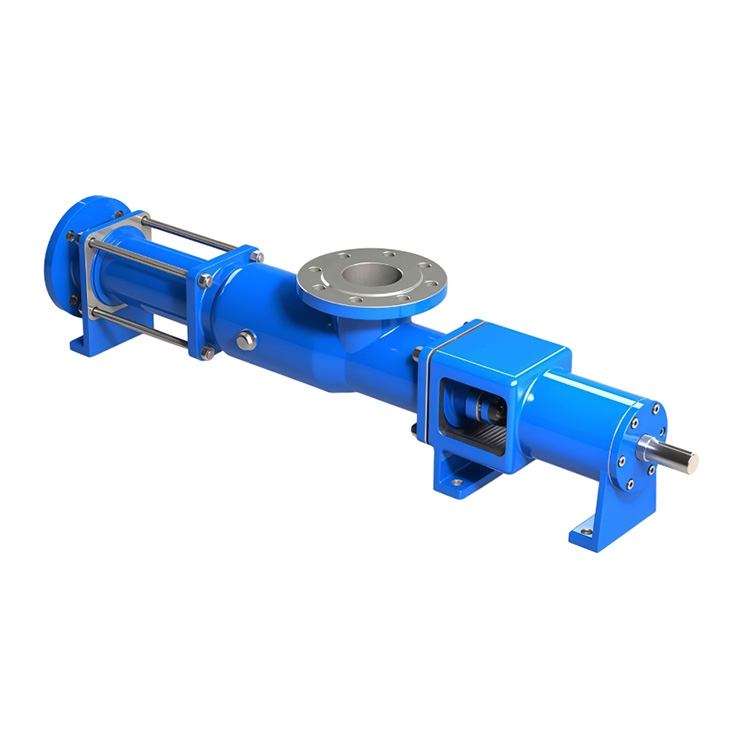
A single external-helix metal rotor turns inside a double-internal-helix elastomeric stator. As the rotor rotates eccentrically, sealed cavities form between the rotor and stator surfaces, moving progressively from suction to discharge. The eccentric motion is accommodated by a flexible drive shaft or universal joint connecting the rotor to the motor. The key to the pump's remarkable media tolerance lies in the elastomeric stator. Because the stator material flexes, it accommodates solid particles, fibrous materials, and irregular inclusions that would jam a rigid-clearance pump. The rubber compound also provides a continuous seal along the rotor length, enabling significant discharge pressure even with highly viscous or non-flowing materials.
Unmatched Media Versatility
The G series can transport clear water with the same reliability as thick sludge containing up to 40 percent solids. It handles viscosities from under 1 centipoise to over 200,000 centipoise. Fibrous materials such as cloth strands, hair, and agricultural fibers pass through without clogging. Soft solids and shear-sensitive materials like food purees and biological sludge retain their integrity because the pump's gentle action does not degrade them. This versatility makes the G series a favorite where fluid characteristics vary widely over a production cycle — operators can switch between different fluids without changing the pump, simplifying inventory management.
Environmental and Water Treatment Applications
Municipal and industrial wastewater treatment plants are among the largest users of single screw pumps. The G series is widely installed for sludge transfer from sedimentation tanks to digesters, dosing flocculants, transferring thickened sludge to dewatering equipment, and recirculating activated sludge. The ability to handle thick, stringy, abrasive sludge without clogging makes it far more reliable than centrifugal or lobe pumps in these applications. The pump's flow rate is directly proportional to rotational speed, giving linear flow characteristics that simplify process control and allow accurate metering for chemical dosing.
Food and Beverage Processing
The food industry demands hygienic pumping equipment. The G series, with a stainless steel rotor and food-grade stator elastomer, meets these requirements. Its progressing cavity action moves products without beating, whipping, or aerating them, preserving texture and quality. Stator materials are available in nitrile rubber, EPDM, and fluoroelastomer compounds complying with FDA and EC regulations. For clean-in-place systems, special connections allow complete cleaning without disassembly. Honey, chocolate, molasses, and other high-viscosity food ingredients are moved efficiently and gently.
Chemical and Petrochemical Applications
In chemical plants, the G series handles polymers, resins, adhesives, latex, paint pigments, and aggressive chemical solutions. The stator elastomer is selected for chemical compatibility, and rotors can be manufactured from stainless steel, duplex, or corrosion-resistant alloys. The low-shear action is ideal for shear-sensitive fluids like polymer emulsions. The pump also handles abrasive media effectively — ceramic slurries, foundry sand suspensions, and mineral tailings. Although the stator will eventually wear in abrasive service, it is designed as a replaceable component that can be changed on-site without special tools.
Choosing the Right Stator Material
The stator is the most critical component. Nitrile rubber is a cost-effective choice for oils and mildly abrasive slurries at moderate temperatures. EPDM offers superior resistance to hot water and many chemicals but is not suitable for petroleum fluids. Fluoroelastomer provides excellent chemical resistance and high-temperature capability at higher cost. The screw pump manufacturer should provide a chemical compatibility chart and recommend the appropriate material. Softer stator compounds seal better at low pressures but wear faster in abrasive service. Harder compounds last longer in abrasives but may not seal as effectively at low pressures.
Maintenance Considerations
The stator and rotor are wearing parts requiring periodic replacement. However, both can be replaced without removing the pump body from the piping, greatly reducing downtime compared with pumps requiring complete disassembly. Keeping a spare stator and rotor in stock is cost-effective for critical applications. With proper material selection and operation within recommended speed and pressure ranges, a stator in non-abrasive service can last one to three years or longer before needing replacement.
References
Karassik, I. J., Messina, J. P., Cooper, P., & Heald, C. C. (2001). Pump Handbook (4th ed.). McGraw-Hill.
Nesbitt, B. (2006). Handbook of Pumps and Pumping. Elsevier.
Bloch, H. P., & Budris, A. R. (2013). Pump User's Handbook: Life Extension (4th ed.). Fairmont Press.
Institute of Water and Environmental Management. (1994). Sludge Pumping and Handling. IWEM.
Brennen, C. E. (1994). Hydrodynamics of Pumps. Cambridge University Press.
 Recommended Products
 Contact us
—— Contact:Mr. Shi
—— Tel:+86 15612730683
—— Email:btclyb@163.com
—— Url:https://www.tianyi-pump.com
—— Address:260 meters east of Xiaoquan Village Committee, Bozhen, Botou City, Cangzhou City, Hebei Province