
NewsDetails
Self-Priming Centrifugal Pumps: Suction Lift, Priming and Installation
author:Tianyi Pump time:2026-10-19 17:56:37 Click:77
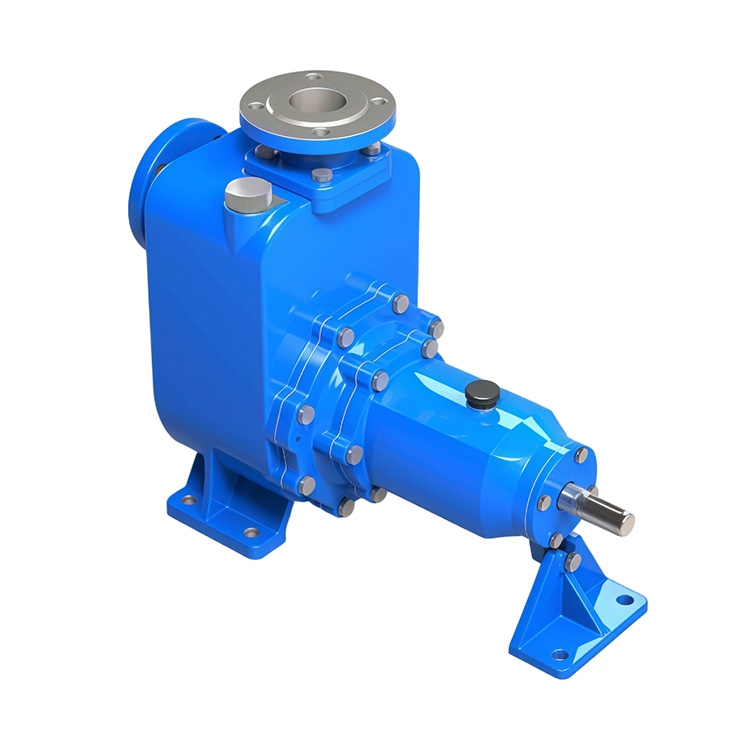
Self-priming does not mean magic, and understanding the small distinction saves a lot of frustration. A unit in this class can evacuate air from its suction line and lift liquid from below once its casing holds enough water to work with. It cannot prime a bone-dry casing, and no model is exempt from the physics limiting suction height. Most priming complaints turn out to be either an air leak or a height the pump was never sold for.
What actually happens during priming
The pump charges its casing with liquid and mixes that liquid with the air in the suction pipe inside a separation chamber. Air leaves through the discharge while the heavier liquid falls back and recirculates. Little by little the suction line empties of air and fills with product. Two consequences follow directly: there must be enough liquid retained in the casing at start-up, and the discharge line must allow air to escape rather than pushing it back. Automatic air release valves and priming chambers make this process quicker and gentler on the seal, especially where operators dry-start from habit.
Realistic suction height
Theoretical atmospheric lift sits near ten metres for cold water at sea level, but sensible designs leave generous margin. Every metre of pipe, every elbow, every strainer and every metre above sea level subtracts from what is available. Warm liquids lose head to vapour pressure, which is exactly the situation in fuel transfer on a hot afternoon. Practically, five to six metres of vertical lift on the suction side plus reasonable pipe losses is a comfortable target, and anything beyond that should be quoted with actual site data rather than assumed. A manufacturer offering a pump advertised at maximum quoted lift without seeing your layout is guessing, and you are the one who will discover it.
Air leaks are the usual culprits
Self-priming units are excellent at pulling in whatever the suction line offers, including an unending supply of air through a hairline leak. The most frequent causes are threaded joints sealed with tape alone, a damaged or hardened cover gasket, a worn mechanical seal letting air in under vacuum, and dry glands that were never tightened or lubricated. A foot valve that does not fully seat lets the column drain back to the source between runs, so the pump re-primes from scratch each time. Checking joints with the pump running and listening for a change in pitch locates most leaks faster than dismantling anything.
Pipe layout mistakes worth avoiding
Avoid high points where air collects and waits; the suction line should rise continuously from source to pump. Keep it short, keep the diameter generous, and prefer long radius elbows over sharp ones. Install isolating valves so maintenance does not require draining the entire system, and size strainers generously because a partially blocked screen starves suction just as effectively as an oversized lift height does. Discharge should never be throttled to control flow for long periods, since that shifts operation away from the intended duty point and builds heat.
Commissioning without drama
Fill the casing through the priming plug before the first run, always. Confirm rotation direction by momentarily jogging the motor and comparing against the arrow on the casing. Open the discharge partially at start so trapped air has somewhere to go, then open gradually as prime establishes. Listen: a pump fighting for prime sounds different from one doing its job, and experienced operators recognise the change immediately. Record running current, discharge pressure and time to prime, because those three figures become your baseline the first time anything looks wrong.
Choosing pumps and suppliers sensibly
Applications for this type include road tanker unloading, bilge and ballast duty, irrigation from open water, emergency drainage, and sump transfer in industrial plants. Specify the vertical lift, horizontal distance, liquid properties and available suction pipe dimensions together. If solids are present, ask whether the design passes them and what happens to the check valve. A competent pump manufacturer will also discuss whether NPSH available truly exceeds NPSH required across the whole operating range, since that margin is what separates a reliable installation from a recurring service call.
Troubleshooting the complaints you will actually hear
"It won't prime" almost always resolves into one of four findings: insufficient casing liquid, an air leak on the suction side, a lift higher than available margin allows, or a discharge line with nowhere for air to escape. “It primes, then loses flow” points instead towards a suction leak that opens as the line warms, a foot valve that does not seat, or a strainer that has quietly filled with debris. “It primes slowly every time” usually means excessive suction volume rather than a worn machine, and shortening the pipe will beat increasing the pump size. “It primes but runs hot” suggests operation far from the duty point with internal recirculation. Whatever the symptom, record the prime time, running current and discharge pressure together; those three numbers narrow the cause faster than any amount of dismantling done on suspicion.
References
Hydraulic Institute, ANSI/HI 1.1-1.5, Rotodynamic (Centrifugal) Pumps — Definitions and Application, Hydraulic Institute.
ISO 9906, Rotodynamic pumps — Hydraulic performance acceptance tests — Grades 1, 2 and 3, ISO.
ISO 9905, Rotodynamic pumps — Hydraulic performance acceptance tests — Grade 1, ISO.
API Standard 610, Centrifugal Pumps for Petroleum, Petrochemical and Natural Gas Industries, 11th Edition, American Petroleum Institute.
Volk, M., Pump Characteristics and Applications, 3rd Edition, 2013.
 Recommended Products
 Contact us
—— Contact:Mr. Shi
—— Tel:+86 15612730683
—— Email:btclyb@163.com
—— Url:https://www.tianyi-pump.com
—— Address:260 meters east of Xiaoquan Village Committee, Bozhen, Botou City, Cangzhou City, Hebei Province