
NewsDetails
High Viscosity Pumps for Resin, Adhesive and Polymer Handling
author:Tianyi Pump time:2026-09-22 09:30:17 Click:140
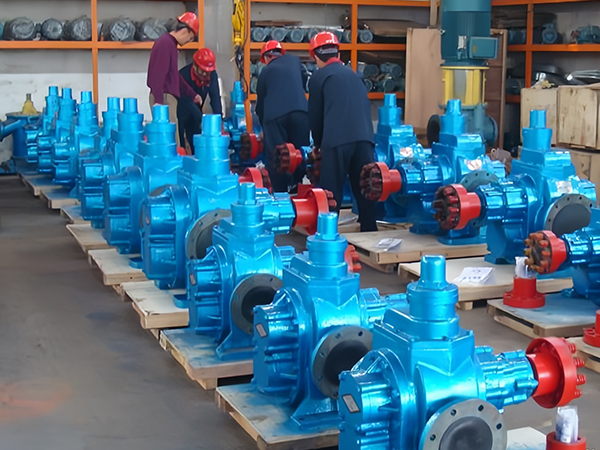
Materials like epoxy resin, hot-melt adhesive, printing ink and heavy polymer solutions share an awkward property: at rest they barely flow, and once warmed they change behaviour minute to minute. Equipment sized for water will fail on all of them, usually at the suction rather than the discharge. Purpose-built high viscosity units use an internal gear arrangement where a crescent-shaped divider separates the filling and discharging zones, creating large cavities that fill slowly and completely.
Why thick fluids starve ordinary pumps
A liquid this resistant will not accelerate quickly enough to keep up with an impeller or a fast-running rotor pair. The result is a partial collapse of the inlet flow, uneven pressure, and loss of delivery. High viscosity designs slow everything down: fewer revolutions per minute, larger passages, and a cavity that exposes its volume gradually so the product has time to enter. Lower internal velocity also means lower shear, which protects formulations that would otherwise break down or change viscosity permanently when worked too hard. For shear-thinning adhesives this distinction can decide whether the product arrives usable at all.
Temperature control and tolerances
Viscosity is a moving target because it tracks temperature closely. Many resin and adhesive processes therefore specify heated pump casings, either jacketed for steam or thermal fluid, or fitted with electric heating elements. A jacketing circuit should cover the pump body, the relief valve, and ideally the head and bearing areas, so the product never meets a cold surface that would freeze it in place. Insulating the assembled unit saves energy and steadies the process. Crucially, heating should be commissioned before the first rotation, since nothing destroys a rotor faster than starting it against solidified material.
Choosing a sensible speed
Speed is the variable most often set by habit rather than calculation. A helpful rule: as viscosity climbs, reduce speed and let displacement do the work. Very thick feeds often run at only a few hundred revolutions per minute, sometimes less. This lowers noise, cuts wear, keeps torque within the drive's continuous rating, and preserves product structure. It also changes the economic picture, since the required duty may push you into a larger frame size. A sound manufacturer will supply performance curves measured at several viscosities, not a single water curve adjusted by assumption, because extrapolation at this end of the range is guessing dressed as engineering.
Sealing and relief protection
Thick fluids complicate sealing. Packing can work when a slight weeping of product is acceptable, since the product itself acts as a lubricant, but modern plants generally prefer mechanical seals with a compatible flush or a heated seal chamber. If that flush fluid contaminates the product, a different arrangement is required, and the choice is worth raising early rather than during commissioning. Every positive displacement pump also needs a relief line returning to the suction side, set conservatively and routed so the product does not cool and solidify inside it.
Cleaning out before shutdown
The failure stories in this industry almost always start the same way: the pump stopped, the product cooled, and the next morning the coupling would not turn. Where the fluid sets below some threshold temperature, a flushing procedure using a compatible solvent or the base oil belongs in the operating manual. Heating should be energised before start-up for the same interval each day. Chemically hardening products, such as two-part adhesives, demand stricter discipline because no amount of heat will rescue a cured cavity.
Getting specifications right with your supplier
Ask for viscosity at both the minimum and maximum process temperature, specific gravity, whether solids or fillers are present, and the expected duty cycle in hours per day. Good pump factories will also request the product's chemical family so they can select rotor material, bushings and seals intelligently. Wear-resistant hardened rotors suit filled compounds, whereas stainless options apply where corrosion or product purity dominate. Documented factory testing with a fluid of similar rheology provides the best assurance that the delivered machine will perform as intended.
References
API Standard 676, Rotary-Type Positive Displacement Pumps, 4th Edition, American Petroleum Institute.
ASTM D445, Standard Test Method for Kinematic Viscosity of Transparent and Opaque Liquids, ASTM International.
Hydraulic Institute, ANSI/HI 3.6, Rotary Pump Tests, Hydraulic Institute.
ASTM A536, Standard Specification for Ductile Iron Castings, ASTM International.
ASTM A743 / A744, Standard Specification for Castings, Iron-Chromium-Nickel, Corrosion Resistant, ASTM International.
Bloch, H.P., and Budris, A.R., Pump User's Handbook, 4th Edition, 2014.
 Recommended Products
 Contact us
—— Contact:Mr. Shi
—— Tel:+86 15612730683
—— Email:btclyb@163.com
—— Url:https://www.tianyi-pump.com
—— Address:260 meters east of Xiaoquan Village Committee, Bozhen, Botou City, Cangzhou City, Hebei Province