
NewsDetails
Gear Pump vs Screw Pump: Choosing the Right Positive Displacement Pump
author:Tianyi Pump time:2026-08-22 17:31:41 Click:153
Both gear pumps and screw pumps are positive displacement machines, yet engineers reach for them in different moments. The choice rarely comes down to which is "better"; it comes down to which failure modes you can live with and which fluid behaviour you must respect. A pump supplier who understands both will walk a buyer through the duty instead of pushing a favourite sku.
Pressure and flow character
Gear pumps are pressure champions in compact packages, comfortably reaching 150 to 250 bar in hydraulic builds while staying small. Screw pumps generally run lower on pressure but excel at moving large volumes of thick liquid with almost no pulsation. If the system needs a tight, high-pressure shot of clean oil, the gear pump wins. If it needs to drain a storage tank of-bitumen without shaking the pipework, the screw pump is the calmer instrument. The two are not competitors so much as neighbours on a spectrum of pressure against gentleness.
Viscosity and shear sensitivity
Below about 20 cSt a gear pump slips and loses efficiency, while a screw pump keeps its grip on thin and medium fluids. Above roughly 100,000 cSt the screw pump still moves product; most gear pumps start to labour. For shear-sensitive goods such as food purees, latex, or cosmetic emulsions, the low-speed screw thread is far kinder than the meshing teeth of a gear set. A manufacturer will ask whether the product degrades under shear before quoting either, because the wrong pick quietly ruins the batch rather than the pump.
Solids, abrasives, and cleanliness
Neither pump welcomes hard solids, but they fail differently. A gear pump chips a tooth and loses sealing; a progressing-cavity screw pump wears its elastomer stator and slowly loses output. Clean, lubricating liquids favour the gear pump for its simplicity and low cost. Dirty or pasty liquids favour the screw design, especially the single-screw variant, which can pass soft solids that would jam a gear set instantly. The maintenance story follows the same lines: gear pumps need precise parts; screw pumps need periodic stator replacement.
Efficiency and total cost
Volumetric efficiency of a well-built gear pump sits high until viscosity or pressure drop, after which slip grows. Screw pumps hold efficiency across a wider viscosity band but cost more up front and carry longer rotors that demand careful alignment. A plant should weigh first price against downtime and spare-part spend. A pump manufacturer that quotes both options with honest duty limits does the buyer a greater favour than one that hides the weak corner of its own product.
Making the final call
Installation footprint and drive
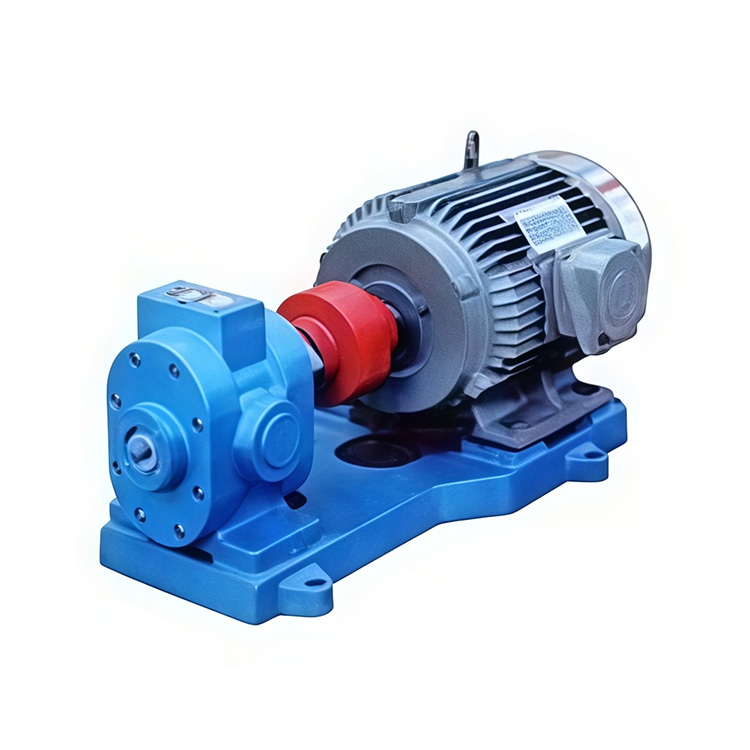
The physical package decides as much as the pump type. A gear pump is small and rigid, often flange-mounted straight onto a motor with no baseplate, which saves space in a packed skid. A screw pump is longer and needs a proper base, alignment, and often a separate gearbox or timing drive, so its footprint and install time are larger. A pump supplier will lay out the envelope early, because a screw pump that will not fit the foundation is no improvement over the gear unit it was meant to replace. Motor size also differs: the screw pump's lower speed may need a larger frame for the same power, and that detail changes the skid weight, the piping, and the crane plan before a single bolt is turned on site during the build.
When to step outside both families
Neither gear nor screw pumps are universal. Thin, clean, high-volume water-like duties belong to the centrifugal pump, which beats any positive displacement unit on efficiency at large flow. Very abrasive slurries favour a peristaltic or diaphragm design that isolates the fluid from precision parts. A pump manufacturer that also builds centrifugal and other types can say this without bias, and that honesty is worth more than a perfect brochure. The right answer is often a mix across the plant: centrifugal for the bulk transfer, gear or screw for the metered, viscous, or pressurized steps. Matching each step to its proper pump family is what keeps the whole system efficient rather than forcing one design to do work it was never meant to handle well.
Write down four numbers: viscosity range, required pressure, allowable pulsation, and solids content. Clean, thin, high-pressure, steady liquid points to a gear pump. Thick, shear-sensitive, gaseous, or solids-laden liquid points to a screw pump. When the duty sits between, ask the supplier for a reference installation running the same product. Real operating history beats any curve on a brochure, and it is the fastest way to remove doubt from the decision.
References
API Standard 676, Rotary-Type Positive Displacement Pumps, 4th Edition, American Petroleum Institute.
Hydraulic Institute, Pump Standards and Customer Guide, ANSI/HI 14.6, Hydraulic Institute.
Karassik, I.J., et al., Pump Handbook, 4th Edition, McGraw-Hill.
Europump, Guide to the Selection and Application of Positive Displacement Pumps, Europump.
Bloch, H.P., and Budris, A.R., Pump User's Handbook, 4th Edition, Fairmont Press.
 Recommended Products
 Contact us
—— Contact:Mr. Shi
—— Tel:+86 15612730683
—— Email:btclyb@163.com
—— Url:https://www.tianyi-pump.com
—— Address:260 meters east of Xiaoquan Village Committee, Bozhen, Botou City, Cangzhou City, Hebei Province