
NewsDetails
Gear Pumps in Lubrication, Fuel, and Hydraulic Power Units
author:Tianyi Pump time:2026-08-20 16:16:28 Click:70
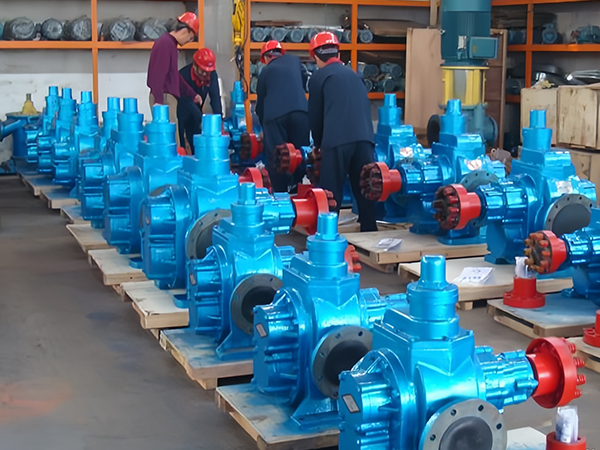
Ask any maintenance engineer to name the most common pump on a machine, and the gear pump is a safe answer. It hides inside transmissions, hydraulic stacks, and engine lube skids, doing unglamorous work that the whole process depends on. A gear pump manufacturer values it for the same reason a buyer does: few parts, predictable output, and a footprint small enough to bolt almost anywhere.
Lubrication systems that never stop
Turbines, compressors, and large gearboxes need a constant film of oil on their bearings, and a gear pump delivers that film at a pressure tuned by a relief valve. Because output tracks speed, the lube pump can be driven straight off the machine shaft, so lubrication rises and falls with rotation. A gear pump supplier will size the relief setting carefully; too high and the filter bursts, too low and the bearing starves. The pump asks little in return beyond clean oil and a strainer coarse enough not to starve it during cold start.
Hydraulic power units
In a hydraulic power unit the gear pump is the heart that turns motor speed into controllable pressure. Pressures of 100 to 210 bar are routine, and the compact external-gear build fits the tight envelope of a manifold block. Fixed displacement keeps the control logic simple: open a valve and flow follows. Where a system needs variable delivery, a pressure-compensated or variable-displacement design takes over, but the basic external gear pump remains the default for cost-sensitive and moderate-duty circuits across factory automation and mobile equipment.
Fuel and light oil transfer
Burning equipment, from boilers to heaters, relies on a gear pump to draw diesel or fuel oil from a tank and push it through a burner nozzle at steady pressure. The pump must pull against suction lift and tolerate the air that enters during tank changeover, which is why internal-gear versions show up where suction is weak. A pump manufacturer specifying for this duty pays attention to the cold viscosity of the fuel, because winter fuel thickens and a pump sized for summer will groan and cavitate when the temperature drops.
Metering and polymer duties
Beyond lubrication, gear pumps meter resins, adhesives, and colourants where the volume per revolution must stay exact. The same trapped-pocket action that defines the design becomes a precision dosing tool. Here, surface finish and tooth profile matter more than raw pressure. A gear pump supplier serving these lines will offer hardened rotors and tight clearance grades, because a fraction of a percent of slip on a metering duty is a visible defect on the finished product, not a hidden loss.
Keeping them running
Filtration and oil cleanliness
A gear pump's tight clearances make it hungry for clean oil, and contamination is the silent killer that wears rotors and side plates long before anyone notices. A gear pump supplier will specify a filtration class tied to the duty, often quoting an ISO 4406 cleanliness code so the buyer knows what clean actually means for that unit. A coarse suction strainer protects against lumps, while a finer pressure-line filter guards the tight clearances downstream. Skipping filtration to save a little money is a false economy; a single batch of gritty oil can erase the clearance that gives the pump its efficiency, after which the only cure is a full rotor-and-bore rebuild that costs more than the filter would have done many times over during the pump's working life on the line.
Noise and vibration as early warnings
Gear pumps speak through their sound. A healthy unit runs with a steady whine that changes pitch with speed; a cavitating one crackles, and a worn one grows louder and warmer as slip climbs. A pump manufacturer will tell operators to learn the normal voice of each unit during commissioning, because a change in that voice is the first sign of trouble. Mounting a simple vibration or temperature sensor turns that instinct into data, letting the plant trend bearing condition and catch a failing set before it seizes. The cheapest maintenance is the kind done on a planned stop triggered by an early warning, not the kind done at two in the morning after the pump has already taken the downstream equipment down with it and the shift is lost.
The failure modes are few and learnable. Cavitation from a blocked suction, wear from contaminated oil, and seal leaks from shaft misalignment account for most stops. A simple routine of clean filtration, correct rotation, and periodic seal inspection carries a gear pump for thousands of hours. Treat it as the precise instrument it is, and this humble pump will outlast far more complicated machinery around it on the plant floor.
References
API Standard 676, Rotary-Type Positive Displacement Pumps, 4th Edition, American Petroleum Institute.
ISO 4406, Hydraulic Fluid Power, Fluids, Method for Coding Level of Contamination by Solid Particles.
Hydraulic Institute, ANSI/HI 14.6, Rotodynamic and Positive Displacement Pump Testing, HI.
Karassik, I.J., et al., Pump Handbook, 4th Edition, McGraw-Hill.
ASTM D4176, Free Water and Particulate Contamination in Distillate Fuels.
 Recommended Products
 Contact us
—— Contact:Mr. Shi
—— Tel:+86 15612730683
—— Email:btclyb@163.com
—— Url:https://www.tianyi-pump.com
—— Address:260 meters east of Xiaoquan Village Committee, Bozhen, Botou City, Cangzhou City, Hebei Province